


Dental implants
Jaw surgery
Lower jaw
Upper jaw
Widening of the jaws
The chin
Jaw angle
Cheek bones
Orthognathic classification
Aesthetic facial surgery
Snoring and sleep apnea
Jaw surgery - Widening of the jaws
The smile distractor is Dr Defrancq’s baby, since he designed and developed it. The device works perfectly and is the most hygienic on the market. The device is available through Titamed® company. Up till now more than 8500 such devices were installed for upper jaw widening worldwide, and the numbers are only increasing.
Historical note: It is interesting to note that the transverse maxillary (and mandibular deficiency) was the last dimension to be mastered in orthognathic surgery. In the 1950s and 1960s, the control of the anteroposterior dimension was the issue (bilateral sagittal split of the lower jaw), followed in the 1970s and 1980s by the mastering of the vertical dimension (with the advent of the Le Fort I osteotomy in the upper). In the 1990s, the work of the Russian surgeon Ilisarov attracted attention in the West. This resulted in the introduction of the principle of osteo distraction, meaning slow and sustained lengthening procedures of bones. The principle was extended to facial bones, and applied in the upper (surgical assisted palatal expansion) as well as the lower jaw. Miniature devices were developed to apply easily and hygienically. The smile distractor (Titamed®) is the most notorious one. The surgical procedure is named SARPE (Surgical Assisted Rapid Palatal Expansion).
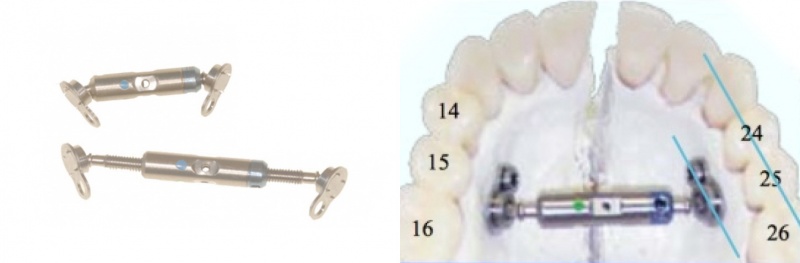 SARPE (Surgical Assisted Rapid Palatal Expansion)
We use a modular device called the smile distractor (Titamed®) to obtain the widening. The device is extremely versatile and thin (4mm) and by far the most hygienic on the market. Moreover, the anchoring is with two mini foot plates on the palatal bone. Those plates adapt completely to the palatal arch form.
The surgery
Maxillary expansion is a totally different surgical process to osteotomies. It is achieved by a phenomenon called osteo-distraction. It is a bony distraction with the action not on the teeth, but directly on the bone. Only the bone gradually becomes physically broader, and new bone is laid down in the fracture sides. The teeth themselves therefore don’t flare up.
Horizontal bony incisions are well above the root of the teeth, and are followed by one vertical bony incision in the middle between the two front teeth. The two halves of the upper jaw (right and left sides) are then very slightly mobilised independently one of each other.
The surgery itself is only the initial phase in skeletal transversal broadening. Widening of the jaw is often the key to a stable result and a pleasant smile.
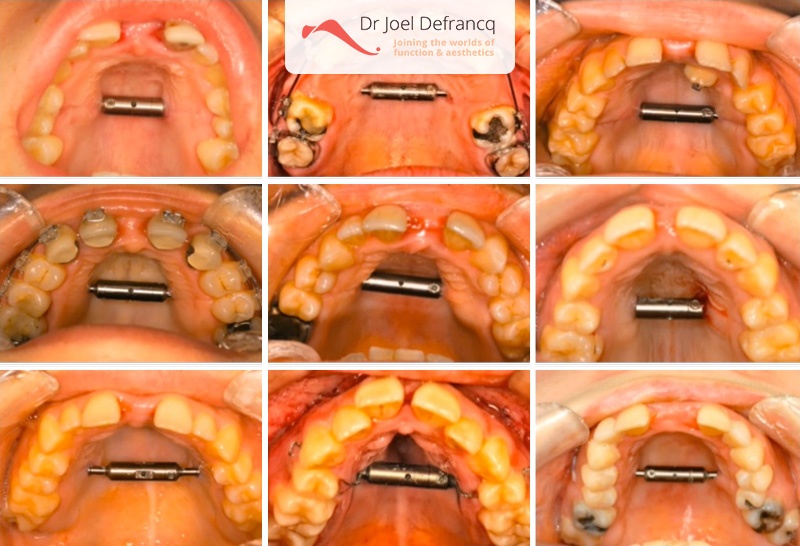
Horizontal bony incisions are well above the root of the teeth, and are followed by one vertical bony incision in the middle between the two front teeth. The two halves of the upper jaw (right and left sides) are then very slightly mobilised independently one of each other.
The surgery itself is only the initial phase in skeletal transversal broadening. Widening of the jaw is often the key to a stable result and a pleasant smile.