


Dental implants
Jaw surgery
Orthognathic classification
Facial balance
Retrognathia class II
Prognatism - pseudo prognatism
Too much teeth showing - Gummy smile
Too less teeth showing
Open bite
Upper jaw too narrow / Smile distrator
Facial asymmetries
Aesthetic facial surgery
Snoring and sleep apnea
Orthognathic classification - Facial balance
 Facial balance is typically studied by dividing the face into horizontal thirds and vertical fifths. Aesthetically pleasing faces almost always fit into those facial proportions.
The frontal plane (Facial length)
The frontal plane is expressed in the horizontal facial thirds and vertical facial fifths as well. It pinpoints the verticality of the face: long face - short face. Furthermore, the frontal plane is mandatory for the study of facial asymmetries. Orthognathic surgery is an excellent way to correct those developmental abnormalities.
The frontal plane is expressed in the horizontal facial thirds and vertical facial fifths as well. It pinpoints the verticality of the face: long face - short face. Furthermore, the frontal plane is mandatory for the study of facial asymmetries. Orthognathic surgery is an excellent way to correct those developmental abnormalities.
- The facial height is divided into three equal parts from the forehead to the eyebrow line, from the eyebrow line to the base of the nose, and from the base of the nose to the base of the chin.
- The full face is divided into two parts, eyes being the midline.
- The lower part of the face from the base of the nose to the chin is divided into two parts, the upper lip forms one-third of it and the lower lip and the chin two-thirds of it.
- The width of the face should be the width of five ‘eyes’.
- The distance between the eyebrow and chin should be equal to the width of the face.
The Sagittal plane (antero-posterior plane - profile plane)
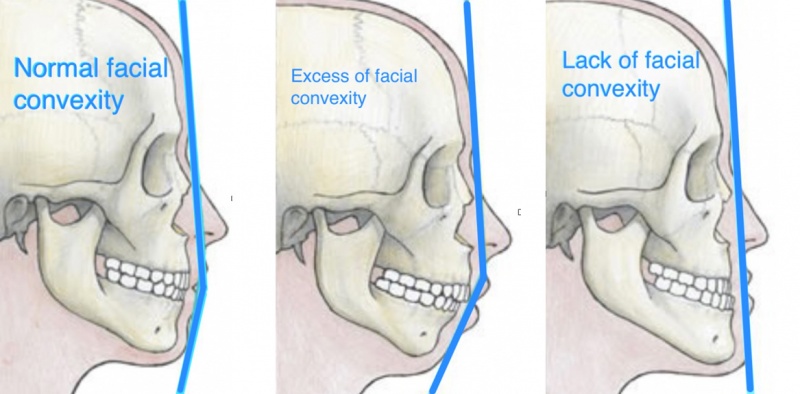 In profile view the harmonious face has an overall soft convex facial flow. Too much facial convexity is felt to be less ideal. This is mostly in patients with a class II, or patients with chin deficiency. Lack of facial convexity (facial concavity or dish-in face) is felt the same way. It occurs mostly in patients with a class III (lower jaw too big or upper jaw too small). The profile view is most often reflected in the dental occlusion
The dental occlusion classification is based on Angle's Classification (Class I - Class II -1& 2 - Class III). Mr Angle was a most famous orthodontist from the beginning of the last century. This dental classification does not refer to vertical discrepancies (any short or long face can be class I II or III) or transversal discrepancies (narrowness broadness).

The coronal plane (Facial Volume)
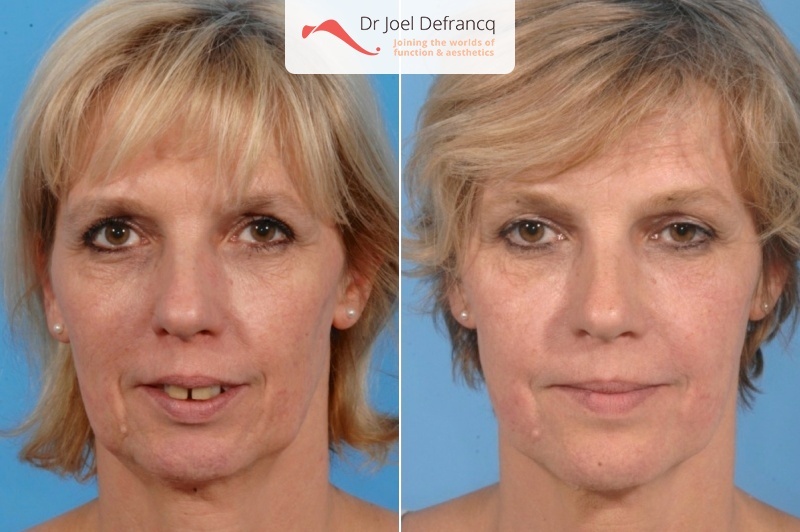 The Coronal plane deals with all the facial surface features in depth, looking at a person ‘facing’ and in 3/4 profile. This is the way that people see themselves in the mirror, the nose, the lips, the cheekbones, the skin textures, and the gonial angles… Surgeries concerning the coronal plane often involve adjunctive surgeries, including bone grafts, liposculpture, a nose job, or gonial angle adjustments etc.